

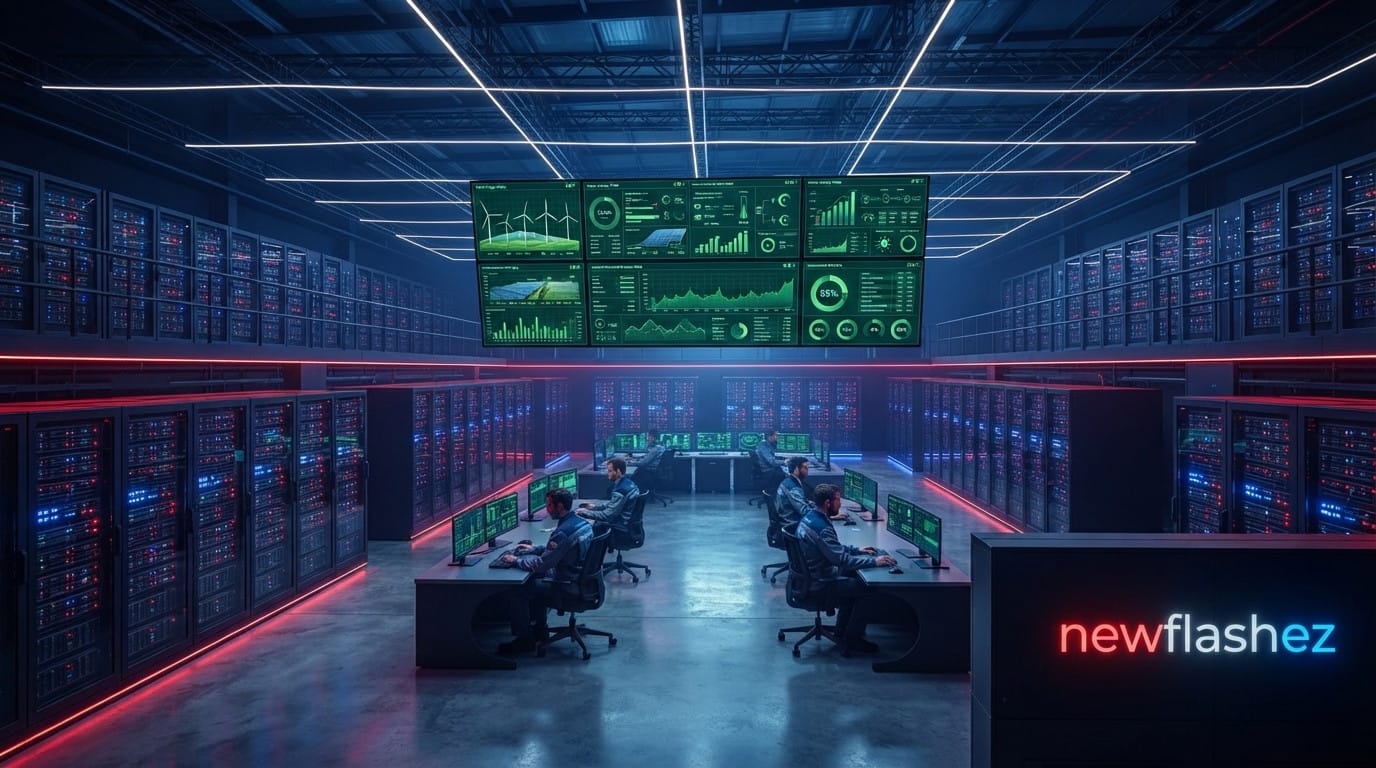
SILICON VALLEY —The rapid expansion of AI Data Centers has reached a historic inflection point. Major technology titans and hardware pioneers are injecting unprecedented capital into cloud computing infrastructure, fundamentally altering the global tech landscape. According to recent market intelligence reports from Bloomberg and Reuters, a landmark strategic partnership valued at up to $60 billion has emerged between tech giant Amazon and semiconductor powerhouse Qualcomm. This massive alliance is specifically engineered to deploy next-generation AI Data Centers at an unprecedented scale, signaling a monumental shift in how enterprise compute power is built, funded, and operated.
Silicon Valley insiders note that the race for computational dominance is no longer confined to software algorithms. The primary bottleneck for generative AI advancement is physical infrastructure. As enterprises worldwide demand higher throughput, lower latency, and massive parallel processing capabilities, the demand for specialized AI Data Centers has skyrocketed. Washington and tech hubs across California are closely monitoring these multibillion-dollar capital expenditures, recognizing that hardware supremacy directly dictates geopolitical and economic leadership in the digital age.
Technical Analysis of Hardware Architecture and Power Grids
From a technical engineering perspective, modern high-density hardware clusters require radical innovations in cooling, power distribution, and server rack architecture. Traditional server farms are utterly unequipped to handle the thermal loads generated by advanced machine learning accelerators. Consequently, engineering teams at Qualcomm and Amazon are pioneering liquid-cooled server modules and custom silicon architectures optimized explicitly for large-scale AI Data Centers.
However, this technological leap introduces severe infrastructure challenges. According to an in-depth analysis published by The Financial Times, the rapid proliferation of hyper-scale computing facilities is placing unprecedented strain on municipal electrical grids. In regions experiencing rapid tech-sector growth, local utility grids struggle to supply the continuous megawatt-scale power required by modern server clusters. Industry experts emphasize that the future success of hyper-scale AI Data Centers hinges on pioneering sustainable energy solutions, including dedicated small modular nuclear reactors (SMRs) and advanced green hydrogen microgrids.
Furthermore, network architecture within these facilities is undergoing a paradigm shift. High-speed optical interconnects and ultra-low-latency switching fabrics are being integrated to eliminate data bottlenecks during distributed model training. These hardware refinements ensure that massive neural networks can synchronize training parameters across tens of thousands of specialized processors without experiencing performance degradation.

Real-World Impact on Enterprises, Energy Markets, and Everyday Users
The ramifications of this infrastructure boom extend far beyond Silicon Valley boardrooms, directly impacting enterprise software developers, regional energy markets, and everyday digital consumers. For corporate enterprises adopting machine learning models, the expansion of high-performance AI Data Centers translates to faster inference times, more robust enterprise security tools, and accelerated software deployment cycles. Cloud providers are racing to offer managed infrastructure that allows businesses to scale AI workloads dynamically without maintaining on-premise supercomputers.
For everyday users, the surging power consumption associated with digital expansion raises valid questions regarding environmental sustainability and consumer electricity tariffs. As data hubs consume a growing percentage of national power outputs, regulatory bodies in both the United States and the United Kingdom are enacting stricter environmental compliance mandates. Tech companies are now pressured to match their power consumption with 100% renewable energy commitments, transforming how green energy procurement is handled across the technology sector. When hardware innovators and cloud providers prioritize energy efficiency alongside computational power, they pave the way for a more sustainable and balanced digital future.
The Road Ahead
As the global technology sector navigates this era of hyper-growth, the strategic alliance between Qualcomm and Amazon highlights the immense capital and engineering power required to sustain the artificial intelligence revolution. Building the physical backbone of tomorrow’s digital economy requires unprecedented collaboration between silicon designers, cloud operators, and energy providers. Ultimately, the successful deployment of modern infrastructure solutions will define which economies lead the next chapter of technological evolution.
