

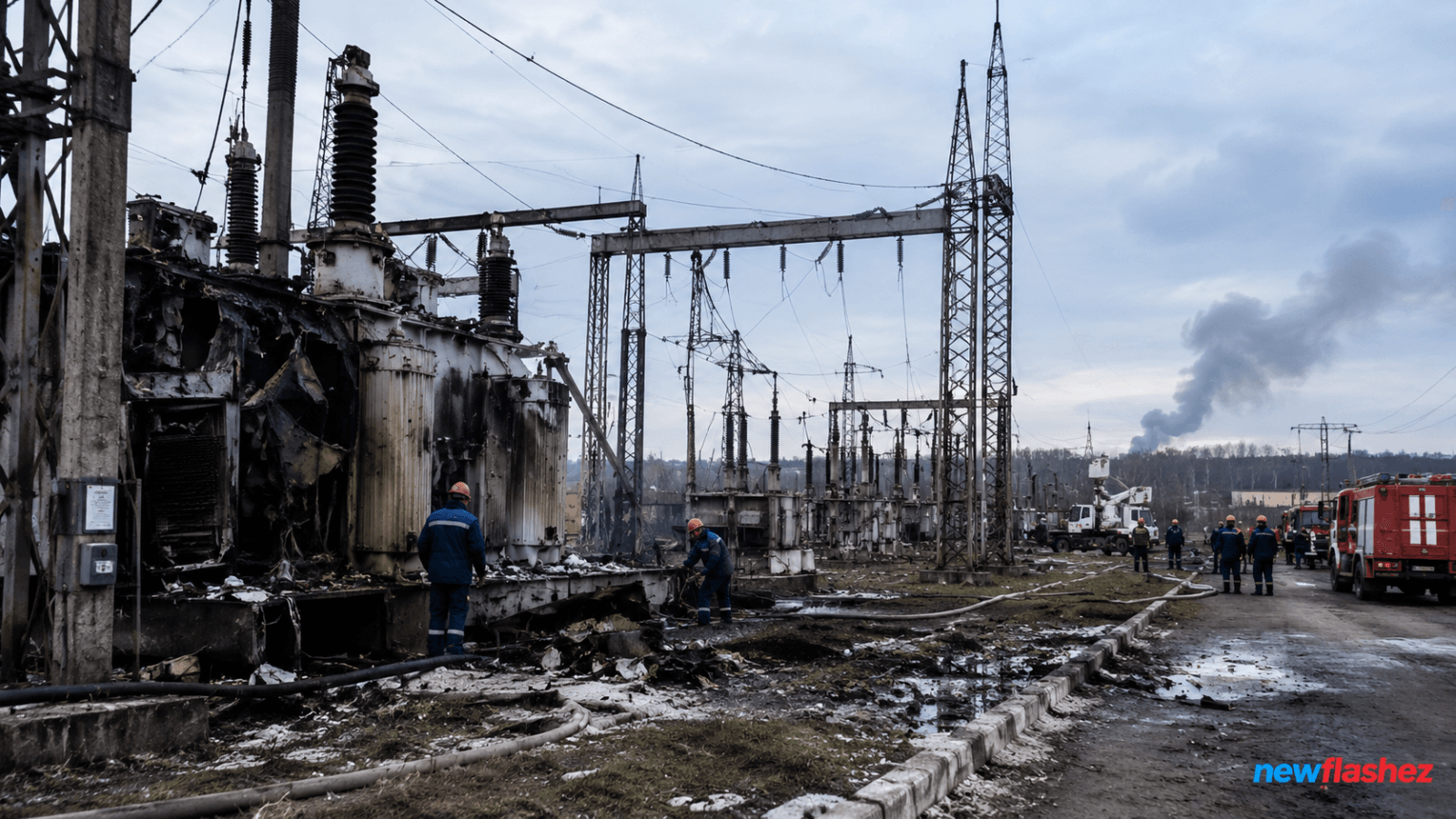
The Ukraine-Russia energy ceasefire announced by U.S. President Donald Trump faced immediate uncertainty Monday after Ukrainian President Volodymyr Zelenskyy reported fresh Russian attacks on energy infrastructure, raising questions about whether the two countries had agreed to halt strikes on critical facilities. The dispute threatens to complicate Washington’s diplomatic efforts, deepen tensions between the United States and Ukraine, and increase concerns about electricity and heating supplies as winter approaches.
Trump announced Sunday that Russia and Ukraine had agreed to stop attacking each other’s energy infrastructure. However, neither government had clearly confirmed a mutually accepted and operational agreement by Monday. Ukrainian officials said Russian strikes continued, while the Kremlin described contacts over a possible ceasefire as ongoing rather than confirming that a truce was in effect.

The conflicting statements have put the proposed Ukraine-Russia energy ceasefire at the center of a wider dispute over military strategy, Western support for Kyiv and the economic consequences of the war.
Ukraine-Russia Energy Ceasefire Faces Immediate Test
Zelenskyy said Russia struck at least six energy targets during overnight and morning attacks on Monday, according to a report published by Reuters. The Ukrainian president identified a gas facility and a petrol station among the targets hit by Russian drones.
The attacks came as Ukrainian authorities reported civilian casualties, damage to residential areas and disruptions to electricity supplies. Kharkiv, Ukraine’s second-largest city, was among the areas affected by the strikes.
The Associated Press also reported that Zelenskyy said Russian forces continued targeting energy facilities despite Trump’s announcement. The reports underscore the difference between declaring a diplomatic understanding and establishing a ceasefire that both military commands recognize and follow.
Ukraine has experienced repeated Russian attacks on its power infrastructure during the war. Damage to electricity generation, transmission facilities and other essential systems can affect water supplies, public transportation, hospitals and household heating.
For Ukrainian officials, the timing is particularly significant. Temperatures typically fall across much of the country during the coming months, increasing demand for electricity and heating while making damaged infrastructure more difficult to repair.
Read the original reporting from Reuters on the reported energy ceasefire and continued strikes and The Associated Press on Zelenskyy’s response.
Why Russia and Ukraine Have Not Confirmed a Mutual Truce
The Ukraine-Russia energy ceasefire remains uncertain because the public statements from the two sides have not established a shared understanding of its terms or implementation.
Zelenskyy said Ukraine was willing to observe an energy truce if Russia also stopped attacking Ukrainian energy facilities. He maintained that Kyiv had not carried out attacks on Russian refineries overnight, according to Reuters.
Moscow, meanwhile, did not confirm that it had accepted the proposed arrangement. Kremlin spokesman Dmitry Peskov said discussions were continuing and reiterated the Russian government’s preference for a broader, long-term peace settlement.
That position leaves several practical questions unanswered. The governments would need to establish which facilities are protected, when restrictions begin, how violations are documented and what happens if one side alleges that the other has breached the agreement.
The absence of clearly confirmed terms also complicates efforts to distinguish between a diplomatic proposal, a political announcement and an enforceable military arrangement.
Energy infrastructure has become a major component of the conflict. Russia has repeatedly attacked Ukrainian energy systems, while Ukraine has targeted Russian oil refineries, logistics facilities and other infrastructure linked to Moscow’s energy sector.
Both countries have sought to impose economic and operational costs on the other through attacks on strategically important facilities. An agreement restricting such operations would therefore require more than a public announcement to establish whether the parties are complying.
Trump’s Energy Policy Adds Tension to U.S.-Ukraine Relations
The dispute over the Ukraine-Russia energy ceasefire comes amid a separate controversy over Russian diesel exports and the Trump administration’s approach to the war.
The Associated Press reported Monday that a U.S.-Russia diesel arrangement and Trump’s criticism of Zelenskyy were viewed in Moscow as diplomatic gains. The report noted that the commercial value of additional Russian diesel exports may be limited relative to overall global demand, but the arrangement could still provide revenue to Russia.
Trump has argued that Ukrainian attacks on Russian oil refineries contribute to higher fuel prices. Zelenskyy has criticized the U.S. approach, warning that additional Russian energy revenue could help finance Moscow’s war effort.
These competing positions reflect a broader disagreement over how Washington should balance domestic energy costs, pressure on Russia and military support for Ukraine.
For Kyiv, restrictions on strikes against Russian energy infrastructure could reduce one of its methods of imposing costs on Moscow while Russian attacks on Ukrainian facilities continue. For Washington, reducing attacks on energy infrastructure could form part of an effort to limit economic disruption and create conditions for negotiations.
The central diplomatic challenge is whether the parties can agree on reciprocal restrictions rather than measures that one side believes would leave it at a disadvantage.
The dispute also raises questions about the durability of U.S.-European coordination. European governments have continued to support Ukraine and have expressed skepticism about whether Russia will honor a proposed energy truce.
U.S. energy policy also extends beyond the Russia-Ukraine conflict. Read our previous report on Trump’s rejection of Iran’s Strait of Hormuz proposal for more context on tensions affecting global energy security.
Washington’s diplomatic challenges extend beyond Ukraine, including tensions with Iran and efforts to sustain regional mediation.
Other diplomatic challenges, including U.S.-China relations and the Iran nuclear standoff, add further complexity to Washington’s foreign policy agenda.
European Union Tightens Pressure on Moscow
European officials responded to the latest developments by maintaining pressure on Russia. Reuters reported Monday that the European Union approved a sanctions package adding 1,569 names to its blacklist, describing it as the bloc’s largest single package of its kind since Russia’s full-scale invasion of Ukraine in 2022.
The sanctions demonstrate that European governments continue to use economic restrictions as a tool to pressure Moscow, even as Washington pursues a separate diplomatic and energy policy.
German Chancellor Friedrich Merz argued that sustained pressure was necessary to encourage serious negotiations, according to Reuters. European officials also expressed doubts about the prospects for a ceasefire that had not been confirmed by both sides.
Their interaction could influence the negotiations. If restrictions on Russian energy exports are eased without a corresponding reduction in military operations, European governments may question whether economic pressure remains an effective negotiating instrument.
At the same time, sanctions alone do not guarantee a diplomatic breakthrough. Their effects depend on enforcement, the availability of alternative markets and the willingness of governments to absorb economic costs.
The So What? Energy Security Could Shape the Next Phase of the War
The immediate significance of the Ukraine-Russia energy ceasefire is not simply whether another diplomatic announcement succeeds or fails. It is whether Ukraine can protect essential infrastructure during the approaching winter and whether the United States and its European partners can maintain a coordinated approach to negotiations.
Continued attacks could increase the need for emergency repairs, backup power, air defense and international assistance. Prolonged electricity disruptions could also affect industrial output, public services and household living conditions.
For Russia, Ukrainian attacks on oil refineries and export infrastructure create a separate challenge by disrupting parts of the energy sector that contribute to government revenue and domestic fuel supply.
The wider economic consequences extend beyond the two countries. Investors and energy traders monitor geopolitical developments because disruptions to production, transport or export infrastructure can affect supply expectations and market prices. However, oil prices are influenced by several factors, and the effect of this particular ceasefire announcement cannot be isolated from other geopolitical and supply risks.
The diplomatic implications are equally important. If Washington, Kyiv and Moscow cannot agree on a verifiable arrangement, confidence in further negotiations could weaken. If they establish clear terms and a credible monitoring process, an energy truce could provide a limited opening for broader talks without resolving the underlying territorial and security disputes.
For now, the Ukraine-Russia energy ceasefire remains an announced proposal whose practical status is disputed. The next indicators to watch are explicit confirmation from both governments, a defined list of protected facilities, evidence of compliance and the response to any reported violations.
For a closer look at the relationship between crude oil prices and financial markets, see our report on Wall Street’s response to falling Brent crude prices.
Frequently Asked Questions
1. Did Russia and Ukraine agree to an energy ceasefire?
President Donald Trump announced on Oct. 11 that Russia and Ukraine had agreed to stop attacking energy infrastructure. However, as of Oct. 12, the two governments had not clearly confirmed a mutually accepted and implemented agreement. Ukraine reported further Russian strikes, while the Kremlin said contacts were continuing.
2. Why is an energy ceasefire important for Ukraine?
Ukraine depends on its electricity and heating infrastructure to support households, hospitals, transportation and industrial activity. Damage to these systems can cause power cuts and disrupt essential services. Protecting energy facilities is particularly important as winter approaches and heating demand rises.
3. How could the ceasefire dispute affect global energy markets?
Continued attacks on energy infrastructure could increase concerns about supply disruptions and geopolitical risk. However, the effect on oil and fuel prices depends on multiple factors, including global demand, production, shipping routes, sanctions and other conflicts. The ceasefire announcement alone does not determine market prices.
Stay informed: Follow newflashez for further reporting on U.S. foreign policy, the war in Ukraine and developments affecting global energy security.
