

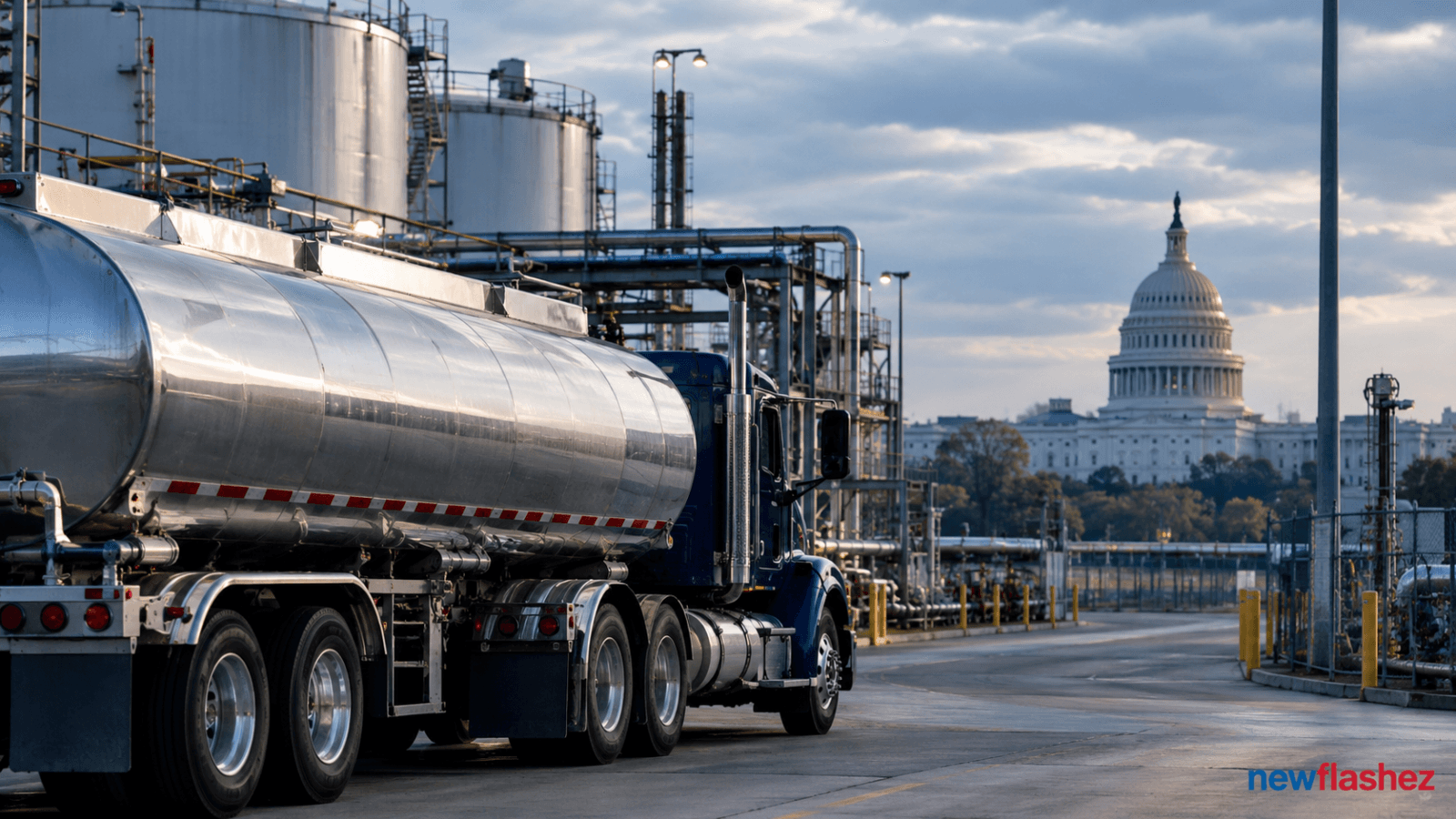
The Trump Russian diesel deal has sparked bipartisan criticism in Washington over U.S. sanctions, relations with Russia and the war in Ukraine. The proposed agreement has also raised questions about whether additional diesel supplies could ease fuel costs for American consumers. The Associated Press reported on the political dispute as lawmakers questioned the administration’s approach.
The controversy comes as the Trump administration seeks to address rising fuel prices and as Congress prepares for the November midterm elections. The agreement also creates a new point of tension between the White House and lawmakers who previously supported restrictions on Russian energy imports following Russia’s invasion of Ukraine. The Associated Press reported on October 13 that criticism of the deal has expanded beyond party lines.
Why Trump’s Russian Diesel Deal Is Facing Opposition
Trump announced the agreement after a conversation with Putin, saying Russia would supply additional diesel to the American and global markets. According to the Associated Press, the proposed deliveries include more than 300,000 tons initially, followed by further shipments in subsequent phases.
The announcement prompted objections from Republican and Democratic lawmakers who questioned whether the administration had adequately consulted Congress and explained how the arrangement would comply with existing restrictions on Russian energy imports.
A bipartisan group of six senators — Republicans Susan Collins, Lisa Murkowski, Thom Tillis and John Curtis, alongside Democrats Jeanne Shaheen and Richard Blumenthal — called on the administration to reverse course. They argued that allowing Russian diesel into the market could provide financial support to Moscow while its war against Ukraine continues.
Other senators have raised concerns about the legal implications. Republican Sen. Thom Tillis questioned whether proceeding with the plan would comply with federal law, while Republican Sen. John Barrasso defended the president’s decision as a possible source of strategic leverage. These competing positions illustrate that the dispute is not simply a partisan disagreement over energy policy.
How the Agreement Could Affect U.S. Sanctions on Russia
The Trump Russian diesel deal has raised questions about how the administration will apply existing sanctions on Russia.
The dispute centers partly on restrictions Congress approved in 2022 to prohibit imports of Russian energy products following the invasion of Ukraine. Those measures were intended to reduce the revenue available to the Russian government as it continued its military campaign.
The Associated Press reported that the earlier legislation established conditions under which the import prohibition could be lifted, including requirements connected to Russian military activity and congressional review. Critics argue that the new diesel arrangement raises questions about whether the administration can proceed without satisfying those requirements.
Congress has also pursued additional measures aimed at increasing economic pressure on Russia and countries that continue buying Russian oil. The diesel proposal has therefore created uncertainty about how the administration intends to reconcile its energy supply objectives with the broader sanctions framework.
The legal question remains distinct from the political criticism. Lawmakers have challenged the agreement, but those objections alone do not establish a final legal determination. The administration’s explanation, the precise terms of the arrangement and any relevant legal review will be important in assessing its status.
The controversy also comes amid wider uncertainty over relations between Washington, Moscow and Kyiv. For background on the conflict’s energy dimension, readers can explore NewFlashez’s earlier report, Ukraine-Russia Energy Ceasefire in Doubt After Fresh Strikes on Critical Infrastructure.
Will Russian Diesel Lower Fuel Prices for Americans?
The effect of the Trump Russian diesel deal on U.S. diesel prices will depend on the volume of additional supply and broader market conditions.
The administration has presented the agreement as a way to increase available fuel supplies and ease pressure on consumers. However, energy specialists cited by the Associated Press have questioned whether the proposed deliveries would be large enough to produce a meaningful reduction in U.S. diesel prices.

The potential benefit depends on more than the volume of fuel entering the market. Prices are also affected by refining capacity, transportation costs, international demand and disruptions to existing supply routes. If Russian shipments are redirected from customers in other countries rather than added to total global supply, the effect on overall prices could remain limited.
Diesel costs have consequences beyond the fuel market. Trucks use diesel to move food, manufactured products and other goods across the country. Farmers also depend on the fuel for agricultural equipment, while delivery companies rely on it to maintain distribution networks.
When diesel becomes more expensive, businesses may face higher operating costs and pass some of those expenses on to customers. That can add pressure to household budgets at a time when fuel affordability has become a significant political issue.
The Associated Press reported that the national average U.S. diesel price reached a record $6.53 per gallon on September 22, according to AAA, before averaging nearly $6.28 per gallon on October 9. Those figures provide context for the administration’s interest in additional supplies, but they do not demonstrate that the Russian agreement will lower prices.
The Ukraine War Remains Central to the Political Dispute
Opponents of the agreement argue that any additional revenue Russia receives from energy sales could weaken the economic pressure intended to constrain its war effort. They also contend that a deal with Moscow could complicate Washington’s position as it seeks to influence the course of the conflict.
The administration’s approach has become another source of friction in its dealings with Ukrainian President Volodymyr Zelenskyy. Trump has publicly blamed Ukraine for contributing to high energy costs, while critics argue that Russia’s invasion and the wider disruption of energy markets must remain central to the debate.
The dispute is unfolding alongside continued disagreement over the possibility of an energy ceasefire between Russia and Ukraine. As reported by the Associated Press, Ukrainian officials have disputed claims that attacks on energy infrastructure have stopped.
The dispute is unfolding alongside continued disagreement over the possibility of an energy ceasefire between Russia and Ukraine. As reported by the Associated Press, Ukrainian officials have disputed claims that attacks on energy infrastructure have stopped.
Readers can follow the broader domestic political context in NewFlashez’s report, Trump Economic Approval Plummets as Inflation Strains American Households.
What the Russian Diesel Deal Could Mean for U.S. Foreign Policy
The central question is whether the proposed arrangement can deliver measurable benefits to American consumers without weakening the objectives of U.S. sanctions policy.
If the additional fuel meaningfully expands supply, the agreement could offer some relief to particular markets. If the shipments largely redirect existing supplies, however, the price benefit could be modest while the political and diplomatic costs remain significant.
The outcome will depend on implementation, the scale and timing of deliveries, market conditions and the administration’s legal justification. Congressional scrutiny will also help determine whether the agreement changes the practical application of restrictions on Russian energy imports.
For lawmakers, the dispute raises a broader question about how the United States balances immediate economic pressures with longer-term strategic objectives. For consumers, the more immediate concern is whether the policy produces a noticeable reduction in fuel and transportation costs.
At this stage, neither the size of any price reduction nor the full legal and geopolitical consequences can be established with certainty. The agreement has nevertheless exposed a clear disagreement in Washington over how to address high fuel prices while maintaining pressure on Russia over its war in Ukraine.
Frequently Asked Questions
1. Why is Trump’s Russian diesel deal controversial?
Critics argue that the agreement could provide Russia with additional energy revenue and conflict with existing U.S. restrictions on Russian energy imports. Supporters say increasing fuel supplies could help address high energy costs.
2. Will Russian diesel reduce U.S. fuel prices?
The effect remains uncertain. Energy experts cited by the Associated Press have questioned whether the proposed shipments would significantly increase total available supply or produce a substantial nationwide price reduction.
Yes. The agreement has intensified disagreements over sanctions, financial support for Russia and Washington’s approach to the war. Its longer-term diplomatic effects will depend on how the policy is implemented and how the conflict develops.
Editorial note: This article is an independently written editorial summary based on publicly available reporting and official material. It is not an original Associated Press article. Information and market conditions may change as further details emerge.
For more coverage of U.S. politics, foreign policy and congressional decisions, visit the NewFlashez Politics section.
